


🔑 Key takeaways
- Most B2B companies allocate 7-12% of projected revenue to marketing
- Budget allocation should tie directly to revenue goals, not last year’s spending
- Balance funds across demand generation (60-80%), brand building (10-20%), and lead nurturing (10-20%)
- Early-stage companies and SaaS startups often spend 15-20%+ of revenue on marketing
- Use both top-down revenue targets and bottom-up campaign planning for accuracy
How to plan B2B marketing budget allocation for 2026
B2B marketing budget allocation for 2026 needs to be tied to revenue goals, not arbitrary percentages from last year. According to Forrester research, the average B2B firm invests around 8% of revenue in marketing, but this number tells only part of the story. Your actual allocation depends on company stage, growth ambitions, and industry dynamics.
We’re in Q4 now. That means marketing teams everywhere are doing the same thing: figuring out next year’s budget while simultaneously trying to make the most out of the remaining budget before December 31st. And honestly? Most teams approach B2B marketing budget planning wrong.
📋 Table of content
- What percentage should B2B companies spend on marketing?
- How should you allocate your B2B marketing budget?
- What are B2B marketing budget allocation best practices?
- What is the 70/20/10 rule for marketing budget?
- How much should B2B SaaS companies spend on marketing?
- What is the purpose of budget allocation in a marketing plan?
- How much should you spend on marketing as a startup?
- Key factors in B2B marketing budget benchmarks
- Aligning budget allocation with revenue growth
- Making your 2026 budget work
What percentage should B2B companies spend on marketing?
The standard range is 7-12% of projected revenue. But let me be clear about something that frustrates me: treating this as gospel is a mistake.
Here’s the reality:
- Mature companies: 5-7% of revenue
- Mid-stage B2B firms: 7-12% of revenue
- Fast-growing companies and startups: 15-20%+ of revenue
- B2B SaaS companies: Often 20-30% in early stages
A common rule suggests B2B companies spend between 2-5% of revenue on advertising alone. That’s just one slice of the total marketing pie.
The Forrester analysis reveals that while 8% is average, top-performing B2B companies often invest more aggressively during growth phases. What you spend matters less than how strategically you spend it.
How should you allocate your B2B marketing budget?
This is where most companies stumble. They copy last year’s allocation or split things evenly. Wrong approach.
The revenue-tied budget framework
Your budget shouldn’t be a random number. It must connect directly to revenue targets. For example, if you’re aiming for €10M in revenue next year and you’re a mid-stage company, you should expect to allocate around 7-12% of that – roughly €700K-€1.2M – in marketing spend.
Start there. Not with “what did we spend last year?”
Splitting your marketing budget across the funnel
Here’s how to think about allocating budget across different stages:
| Funnel stage | Budget % | Primary focus |
|---|---|---|
| Demand Generation & Direct Response | 60-80% | New lead acquisition, paid campaigns, pipeline creation |
| Brand Building & Awareness | 10-20% | Long-term recognition, thought leadership, PR, content |
| Lead Nurturing & Retention | 10-20% | Existing lead nurturing, upsell/cross-sell, advocacy |
This split works for most B2B companies. But—and this matters—early-stage companies should weight heavier toward demand generation (maybe 70-80%), while established firms can afford to invest more in brand building (20-30%).
What are B2B marketing budget allocation best practices?
Let me walk you through a framework that actually works. I’ve seen too many teams overcomplicate this. The following infographic summarize the process in 5 steps, and you can find more details below.
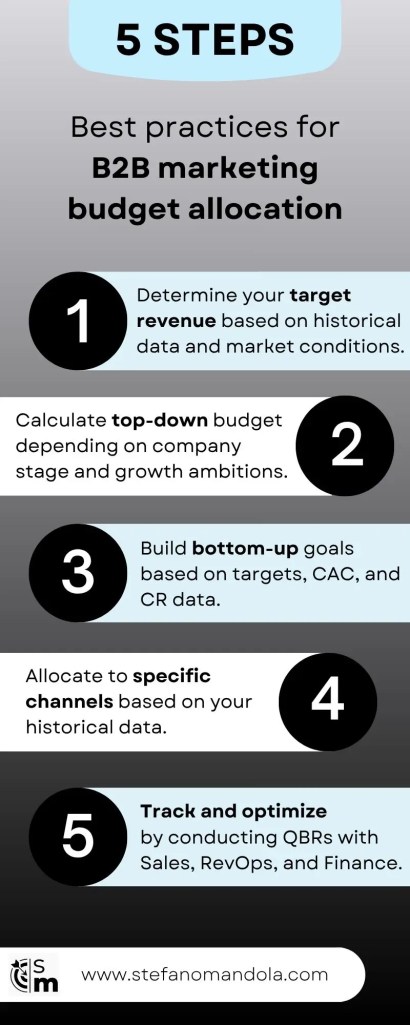
Step 1: Determine your target revenue
Forecast your projected revenue for 2026. Ground this in historical performance, realistic market conditions, and conversion data. Be realistic, not optimistic. This is your north star. Define it collaboratively with Sales leadership, Revenue Operations, and Finance, since marketing budgets must align with overall revenue strategy.
Step 2: Calculate your top-down budget
Apply your percentage to projected revenue. If you’re projecting €5M and you’re allocating 10%, that’s €500K. Simple math, but it grounds everything else. The actual percentage should be guided by benchmarks (e.g., 7–12% for mid-stage B2B SaaS) and aligned with Finance and Sales leadership to ensure it matches growth targets and company margins.
Step 3: Build bottom-up campaign goals
Now work backwards. What specific outcomes do you need?
- How many SQLs (Sales Qualified Leads)?
- What’s your target CAC (Customer Acquisition Cost)? And does it align with LTV (ideally 3–5× LTV:CAC ratio)?
- How many deals are needed to hit revenue goals? At what average contract value (ACV)?
This bottom-up planning keeps you honest. If the numbers don’t align with your top-down budget, something needs adjusting.
Step 4: Allocate to specific channels
Distribute funds based on what’s actually working, considering your historical data. Here’s where allocating budget for digital marketing in B2B gets tactical:
- Content marketing and SEO
- Paid advertising (LinkedIn, Google Ads–and avoid these costly B2B Google Ads mistakes)
- Account-Based Marketing campaigns
- Events and webinars
- Marketing technology and tools
- Analytics and attribution
Step 5: Track and optimize relentlessly
Conduct structured quarterly business reviews with Sales, RevOps, and Finance. If something’s not working by month three, shift budget. Don’t wait until Q4 to realize you overspent on channels with poor ROI.
What is the 70/20/10 rule for marketing budget?
The 70/20/10 rule offers a smart framework for balancing risk and innovation:
- 70% goes to proven, core strategies that you know work
- 20% funds innovative tactics that show promise
- 10% supports experimental initiatives and testing
This rule prevents you from getting too conservative or too reckless. Your 70% keeps revenue flowing. Your 20% positions you for growth. Your 10% might discover your next breakthrough channel.
I like this framework because it builds in permission to experiment without burning too much budget.
How much should B2B SaaS companies spend on marketing?
B2B SaaS marketing budget allocation plays by different rules. SaaS companies typically spend more—often significantly more—than traditional B2B businesses.
Here’s the breakdown:
- Pre-product-market fit: 30-60% of revenue (sometimes more)
- Early growth stage (1M-5M ARR): 35-50% of revenue
- Scaling stage: 15-25% of revenue
- Mature SaaS: 8-15% of revenue
Why so high? Because SaaS businesses require continuous customer acquisition to hit growth targets. The subscription model means you’re playing a longer game. For example, you might spend €5,000 to acquire a customer worth €500 annually, but if they stay for five years, and your margins are healthy, the math works.
What is the purpose of budget allocation in a marketing plan?
Let’s answer this directly: budget allocation in your marketing plan serves as your strategic roadmap. It forces prioritization. Without proper allocation, you’re just spending money. With it, you’re investing in specific outcomes.
Budget allocation:
- Aligns marketing spend with business objectives
- Prevents overspending on vanity metrics
- Ensures balanced investment across the customer journey
- Creates accountability for marketing performance
- Enables data-driven decision making
It’s the difference between “we spent €500K on marketing” and “we invested €500K to generate 2,000 SQLs at €250 CAC.”
How much should you spend on marketing as a startup?
Startup marketing budgets require a different mindset. You’re not maintaining market position. You’re fighting to create one.
Most B2B startups should allocate 15-25% of revenue to marketing. Some go higher. If you’re venture-backed and growth is the priority, 30-40% isn’t unusual.
But here’s what matters more than the percentage: capital efficiency. Every dollar needs to work harder. Focus on:
- High-ROI channels first (usually content and targeted paid)
- Account-Based Marketing for enterprise deals
- Community building and word-of-mouth
- Strategic partnerships over broad campaigns
- AI-powered SEO strategies that maximize organic reach with limited resources
Startups can’t afford to waste budget on “brand awareness” that doesn’t convert. Be ruthless about ROI.
Key factors in B2B marketing budget benchmarks
Understanding B2B marketing budget benchmarks helps, but don’t let them dictate your strategy. Consider these factors:
Company stage
Your maturity level changes everything. A Series A SaaS company and a 50-year-old manufacturing firm shouldn’t allocate budgets the same way.
Growth goals
Aggressive growth requires aggressive spending. If you’re targeting 100% YoY growth, 7% of revenue won’t cut it.
Industry dynamics
Competitive industries demand more spend. If your competitors are outspending you 3:1, you’ll need to get creative or increase investment.
Average deal size
High-ticket B2B sales justify higher CAC. If your average deal is €100K, spending €15K to acquire that customer makes sense.
Account-Based Marketing focus
ABM strategies concentrate spending on high-value accounts rather than casting wide nets. This changes how you allocate within your budget—less on broad awareness, more on targeted account engagement.
Content and martech infrastructure
Don’t overlook foundational investments. Whether you’re building on WordPress with proper SEO optimization or other platforms, your technical foundation affects every dollar you spend on content and campaigns.
Aligning budget allocation with revenue growth
The biggest mistake I see? Companies base 2026 budgets on 2025 spending instead of 2026 goals.
Your marketing budget should scale with revenue targets, not with what you spent last year. If you’re targeting 50% revenue growth, your marketing budget likely needs to grow too—though not necessarily at the same rate.
The key is efficiency. As you mature, your CAC should decrease (or at least stabilize) even as you grow. If you’re spending more but efficiency is declining, something’s broken.
Making your 2026 budget work
Here’s my honest take after watching and contributing to B2B marketing teams budget plannings: the exact percentage matters less than the process.
Start with revenue goals. Build backward to required marketing outcomes. Allocate budget to channels and tactics that can deliver those outcomes. Then—and this is critical—stay flexible enough to adjust quarterly based on what’s actually working.
The companies that win in 2026 won’t be the ones with the biggest budgets. They’ll be the ones who allocate strategically, measure obsessively, and optimize constantly. Your Q4 planning starts now. Make these decisions count.
Need help developing your B2B marketing strategy? Shoot me a message on LinkedIn and let’s discuss how we can work together.
Featured image: Freepik



 Stefano Mandola